CAPABILITIES
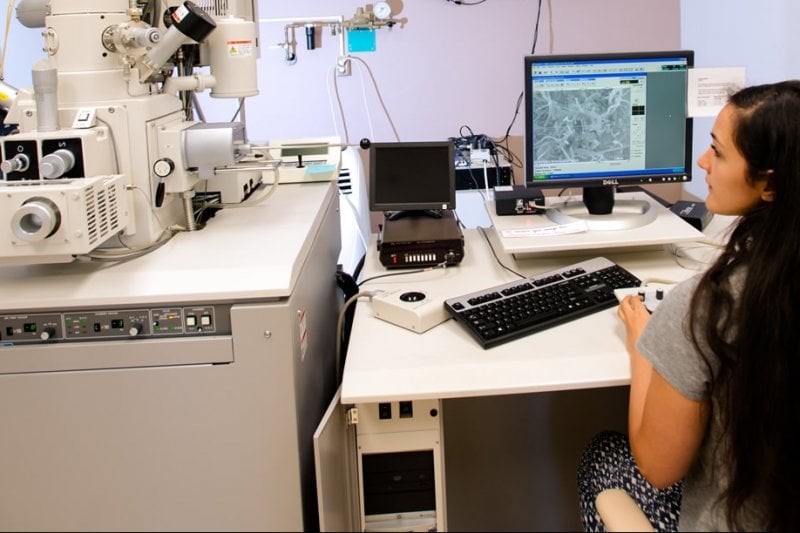
Imaging modes include secondary electrons, backscattered electrons and X-rays. Under ideal conditions, resolution in secondary electron imaging mode is 5 nm. Images can be recorded with Polaroid film and/or digital image capture through the Geller dPict module with subsequent output to a 1200 dpi laser printer.
Characteristic X-rays can be detected from as little as a 1 cubic micrometer volume of the specimen. Elements from atomic number 5 (B) to 92 (U) can be detected in concentrations above 0.001 wt% element. Analysis modes include qualitative, standardless, and fully rigorous standards-based quantitative analysis. Additional capabilities of the Geller software package include analog and digital X-ray mapping and report generation. Both analog and digital X-ray or compositional mapping are available.
The Geller automation/analysis system is interfaced to the campus network so all user data can be downloaded to user storage system from the laboratory.
About JEOL: JEOL USA is a leading supplier of scanning electron microscopes, transmission electron microscopes, scanning probe microscopes, mass spectrometers, NMR spectrometers, and semiconductor tools for scientific and industrial purposes. Logo used with permission. Disclaimer.
About Geller: Geller MicroÅnalytical Laboratory, Inc. provides analytical services and design and manufacturing of a limited number of unique products that are directly related to microanalysis, including computer control systems used in ACMAL. Logo used with permission. Disclaimer.
TRAINING
eTraining
Free online eTraining is available for this instrument. This self-paced tutorial and reference content does not replace course requirements for authorized usage.
|
Available topics related to this instrument:
JEOL JSM-6400 SEM
Microanalysis
Support |
Courses
Michigan Tech offers many undergraduate and graduate courses related to materials characterization.
Two of these courses offer direct, hands-on training in scanning electron microscopy:
MY 4200 - Introduction to Scanning Electron Microscopy
Practical training on the operation and image formation in a scanning electron microscope (SEM). Applications of the SEM to the analysis of metallic, ceramic, geological and biological materials are discussed, including qualitative chemical analysis using energy dispersive spectroscopy.
Credits: 2.0 Lec-Rec-Lab: (1-0-3) Semesters Offered: Fall
Restrictions: May not be enrolled in one of the following Class(es): Freshman, Sophomore
MY 5200 - Advanced Scanning Electron Microscopy
Basic design and operating principles of scanning electron microscope (SEM) with discussions on interactions of electrons with solids and resulting signal production, for analysis of heterogeneous materials using X-ray microanalysis, and applications to surface science. Includes practical training on advanced operation of SEM and FE-SEM (FE=field emission)* instruments with an emphasis on the production of high resolution images and quantitative X-ray analysis of specimen composition based on real and virtual standards. (*if available)
Credits: 3.0 Lec-Rec-Lab: (2-0-3) Semesters Offered: Summer
Restrictions: Must be enrolled in one of the following Level(s): Graduate

Last updated October 15, 2007
Disclaimer
This is to notify you that the material you are accessing is not an official web page of Michigan Technological University, MCFF, or ACMAL. While MTU recognizes the constitutional right of free speech for its University users of the Internet and the World Wide Web, it is not responsible, and hereby disclaims all liability for any data, information, or opinions contained in unofficial web pages. Any comments related to the contents of personal home pages should be directed to the author of the pages. There is no affiliation between ACMAL and JEOL. There is no affiliation between ACMAL and Geller. |